Huaraches in the Mercado de Abastos, Oaxaca
Posted: November 6, 2012 Filed under: Huarache Culture, Huarache Sandals | Tags: メキシコのサンダル, ワラチ, चमड़े के सैंडल, बुना सैंडल, मेक्सिको सैंडल, हस्तनिर्मित सैंडल, Crafts, 编织凉鞋, Мексиканские сандалии, 革のサンダル, 멕시코 샌들, Gewebten Sandalen, Geweven Sandalen, Handcrafted, Handgefertigte Sandalen, Handgjorda Sandaler, Handmade Sandals, Håndlagde Sandaler, Huarache, Huarache Sandals, Huaracheria, Huarachero, Huaraches, 짠 샌들, Lädersandaler, Ledersandalen, Meksikanske Sandaler, Mexicaanse Sandalen, Mexican Crafts, Mexican Footwear, Mexican Sandals, Mexico, Mexikanischen Sandalen, Mexikanska Sandaler, тканые сандалии, Oaxaca, Sandales à la main, Sandales en Cuir, Sandales Mexicains, Sandales Tissées, Sandali fatti a mano, Sandali in Pelle, Sandali Intrecciati, Sandali Messicani, Sandalias de Cuero, Sandalias Guaraches, Sandalias Hechas a Mano, Sandalias Tejidas, Sandals, Skinn Sandaler, Sustainable Footwear, Traditional Footwear, Vävda Sandaler, Vevde Sandaler, Woven Footwear, Woven Sandals, 墨西哥凉鞋, 手工凉鞋, 手作りのサンダル, 不織布サンダル, المكسيكي الصنادل, المنسوجة الصنادل Leave a commentAlthough visitors to Oaxaca mostly visit the central markets for crafts and souvenirs, there are many Huaracherias tucked deep inside the sprawling main Oaxaca market, called Mercado de Abastos.
Inside the Mercado de Abastos there are a large variety of Huaraches and plenty of light to see all the crafted details.


Unlike the other markets in Oaxaca at the Mercado de Abastos you can also see Huaracheros making Huaraches. Most of the Huaracheros and Huaracherias have been here for over 40 years.

Most Oaxacan Huaraches have unique marking designs on the leather, this is called “Marcado”.


There were some interesting “Sachileno” Huaraches with 4 and 6 “Pasadas”.


Some elegant “Tejido” Huaraches.


Also a variety of “Cacles”, both fashion designs


And the traditional “Cacles” that are nowadays very hard to find anywhere in Mexico.


Pachones in Mexico City
Posted: November 6, 2012 Filed under: Uncategorized | Tags: capisallo, capote de plumas, Pachones, Rain Wear, Woven Palm Rain Capes 2 CommentsA few months ago I wrote a post about Mexican Woven Palm Rain Capes, a millenary design that since the introduction of synthetic materials has become a craft and product on the verge of extinction.
Consequently finding where to purchase a Michoacan “Capote de Plumas”, or Pueblan “Capisallo” has become virtually impossible.

Until recently when I came across some “Pachones” for sale at Jarcieria “El Baratero” in Mexico City.

The “Pachones” come from the State of Hidalgo and are made with the same weave as the “Capisallo” from Northern Puebla.


For anyone wishing to buy one of the few remaining palm rain capes in the world, without venturing to the remotest villages in Mexico, visit Jarcieria “El Baratero” in the central Mexico City.
Jarcieria “El Baratero” is very accessible and is located only a few blocks from the Central Zocalo, on Calle Jesús María No.134 (on the corner with Calle Regina).
VISVIM Areni Folk – Burras From Japan
Posted: August 24, 2012 Filed under: Uncategorized | Tags: Areni, ハンドメイドのレザーブーツ, メキシコのブーツ, Boots, burra, Burras, Footwear, Luxury Footwear, Mexican Crafts, Mexican Footwear, Mexico, VISVIM 2 CommentsJapanese star brand VISVIM released their Areni Folk footwear design for Summer 2012. The Areni Folk design appears a nice refinement of a traditional Mexican footwear called Burras and is made using Italian vegetable tanned leathers, a cork footbed and a Vibram Gumlite sole (the Suede Folk version).


Burras also known as Teguas are traditional hand crafted Mexican work boots and like Huaraches are usually made using vegetable tanned leathers and used car tyre soles.
Hand crafted Burras can be bought at most Mexican city markets in the geographical area between Colima and Queretaro (Central Western Mexico). I noticed some for sale as far away as Merida, but few were sold in Central Eastern Mexico.
The quality and designs vary, they can be as clean as this design from the Municipal Market in Morelia, Michoacan,

to funky like these Burras from the main market in Leon, Guanajuato.

I also found some nice Burras also in Irapuato, Guanajuato.


And in La Piedad, Michoacan.

“Imitation is the sincerest form of flattery” – Charles Caleb Colton
Patina – Huaraches and Sunshine
Posted: August 21, 2012 Filed under: Huarache Culture, Huarache Sandals, Rare Huaraches | Tags: メキシコのサンダル, ワラチ, चमड़े के सैंडल, बुना सैंडल, मेक्सिको सैंडल, हस्तनिर्मित सैंडल, Crafts, 编织凉鞋, Мексиканские сандалии, 革のサンダル, 멕시코 샌들, Footwear Design, Gewebten Sandalen, Geweven Sandalen, Handcrafted, Handgefertigte Sandalen, Handgjorda Sandaler, Handmade Sandals, Håndlagde Sandaler, Huarache, Huarache Sandals, Huarachero, Huaraches, 짠 샌들, Lädersandaler, Ledersandalen, Meksikanske Sandaler, Mexicaanse Sandalen, Mexican Crafts, Mexican Sandals, Mexico, Mexikanischen Sandalen, Mexikanska Sandaler, тканые сандалии, Sandales à la main, Sandales en Cuir, Sandales Mexicains, Sandales Tissées, Sandali fatti a mano, Sandali in Pelle, Sandali Intrecciati, Sandali Messicani, Sandalias de Cuero, Sandalias Guaraches, Sandalias Hechas a Mano, Sandalias Tejidas, Sandals, Skinn Sandaler, Traditional Footwear, Vävda Sandaler, Vevde Sandaler, Woven Footwear, Woven Sandals, 墨西哥凉鞋, 手工凉鞋, 手作りのサンダル, 不織布サンダル, المكسيكي الصنادل, المنسوجة الصنادل Leave a comment
Like wine, Huaraches get better with age. You grow an attachment to Huaraches as they change and age with you, molding to the shape of your foot and slowly changing to a rich dark honey colour. An example of this colour change can be seen on this pair of Huaraches Doble (also known as Recargado) made by Huaraches Martinez in Mazamitla, Jalisco.


My Petatillos – Huaraches Get Better With Age
Posted: August 10, 2012 Filed under: Huarache Sandals, Huaraches Jalisco, Rare Huaraches | Tags: メキシコのサンダル, ワラチ, चमड़े के सैंडल, बुना सैंडल, मेक्सिको सैंडल, हस्तनिर्मित सैंडल, Crafts, 编织凉鞋, Мексиканские сандалии, 革のサンダル, 멕시코 샌들, Gewebten Sandalen, Geweven Sandalen, Handgefertigte Sandalen, Handgjorda Sandaler, Handmade Sandals, Håndlagde Sandaler, Huarache, Huarache Sandals, Huaraches, 짠 샌들, Lädersandaler, Ledersandalen, Meksikanske Sandaler, Mexicaanse Sandalen, Mexican Crafts, Mexican Sandals, Mexikanischen Sandalen, Mexikanska Sandaler, тканые сандалии, Sandales à la main, Sandales en Cuir, Sandales Mexicains, Sandales Tissées, Sandali fatti a mano, Sandali in Pelle, Sandali Intrecciati, Sandali Messicani, Sandalias de Cuero, Sandalias Guaraches, Sandalias Hechas a Mano, Sandalias Tejidas, Sandals, Skinn Sandaler, Vävda Sandaler, Vevde Sandaler, Woven Sandals, 墨西哥凉鞋, 手工凉鞋, 手作りのサンダル, 不織布サンダル, المكسيكي الصنادل, المنسوجة الصنادل Leave a commentHuarache Blog readers sometimes ask me how many pairs of Huaraches I own?
Although I own about 6 pairs mostly for reference, I prefer to take photos and document.
Year round I wear this pair of Huaraches from Central Michoacan, which well combine two opposing yet essential elements of the Huarache, rustic and sophistication.
Interestingly the vegetable tanned aniline leather, rather like skin has become darker and golden with exposure to the sun over this last year (patina). A fascinating design transformation, this is arguably a good example of how footwear can look better with age.
Because the sole has been nailed instead of glued, when it wears down it can easily be replaced.


Leather Sandals, Lädersandaler, الجلود والصنادل, 皮凉鞋, Leren Sandalen, Sandales en Cuir, Ledersandalen, चमड़े के सैंडल, Sandali in Pelle, 革のサンダル, Skinn Sandaler, Sandalias de Cuero, Lädersandaler, Huaraches, Guaraches, Mexican Sandals, Sandali Messicani, 멕시코 샌들, मेक्सिको सैंडल, Sandales Mexicains, Meksikanske Sandaler, Mexicaanse Sandalen, メキシコのサンダル, 墨西哥凉鞋, Мексиканские сандалии, Mexikanska Sandaler, Mexikanischen Sandalen, ワラチ, ワラチ, المكسيكي الصنادل, Woven Sandals, Sandali Intrecciati, 编织凉鞋, Gewebten Sandalen, Geweven Sandalen, Sandales Tissées, 不織布サンダル, 짠 샌들, Vevde Sandaler, тканые сандалии, Sandalias Tejidas, Vävda Sandaler, المنسوجة الصنادل, बुना सैंडल, Handmade Sandals, Sandali fatti a mano, 手工凉鞋, Sandales à la main, हस्तनिर्मित सैंडल, 手作りのサンダル, Håndlagde Sandaler, Sandalias Hechas a Mano, Handgjorda Sandaler, Handgefertigte Sandalen, الصنادل المصنوعة يدويا
Huaraches at The Mercado Libertad in Guadalajara
Posted: August 8, 2012 Filed under: Huarache Culture, Huarache Sandals, Huaraches Jalisco | Tags: メキシコのサンダル, ワラチ, चमड़े के सैंडल, बुना सैंडल, मेक्सिको सैंडल, हस्तनिर्मित सैंडल, Burras, Crafts, 编织凉鞋, Мексиканские сандалии, 革のサンダル, 멕시코 샌들, Gewebten Sandalen, Geweven Sandalen, Handgefertigte Sandalen, Handgjorda Sandaler, Handmade Sandals, Håndlagde Sandaler, Huarache, Huarache Sandals, Huaraches, 짠 샌들, Lädersandaler, Ledersandalen, Meksikanske Sandaler, Mercado San Juan de Dios, Mexicaanse Sandalen, Mexican Sandals, Mexico, Mexikanischen Sandalen, Mexikanska Sandaler, тканые сандалии, Pachuco, Sandales à la main, Sandales en Cuir, Sandales Mexicains, Sandales Tissées, Sandali fatti a mano, Sandali in Pelle, Sandali Intrecciati, Sandali Messicani, Sandalias de Cuero, Sandalias Guaraches, Sandalias Hechas a Mano, Sandalias Tejidas, Sandals, Skinn Sandaler, Tamazula Huaraches, Traditional Footwear, Vävda Sandaler, Vevde Sandaler, Woven Sandals, 墨西哥凉鞋, 手工凉鞋, 手作りのサンダル, 不織布サンダル, المكسيكي الصنادل, المنسوجة الصنادل 7 CommentsHuarache Blog often receives comments from readers asking where to buy Huaraches and the first place I recommend is the Mercado Libertad also known as Mercado San Juan De Dios in Guadalajara. Located centrally in the modern city of Guadalajara the Mercado is very accessible and tourist friendly.
The Mercado San Juan De Dios is one of the biggest indoor markets in the world and probably sells the largest volume of Huaraches in all of Mexico. Below are only a few of the styles for sale at this phenomenal market.

There are many Huarache styles for sale here, from delicate women’s styles to thick men’s work styles (click on the images for larger size)


Huaracheria Ester was my first stop when I began Huarache Blog 2 years ago and the owner was very helpful in explaining some the different kinds of Huaraches.

From the most popular ‘Pachuco’ Huarache,

to the ‘Zapatilla’ Huarache.

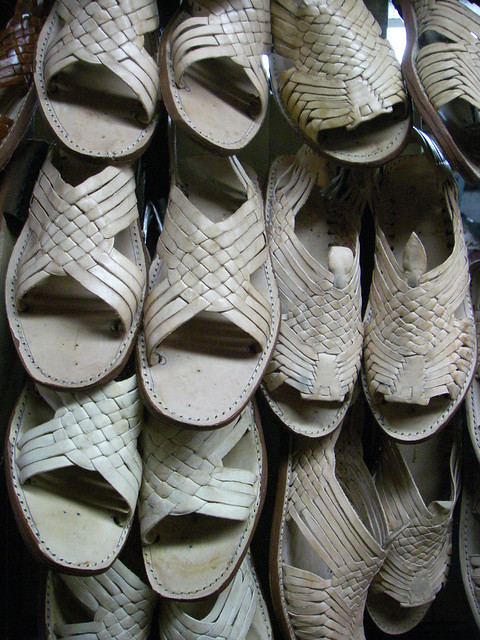
From the ‘Correa Blanca’ chrome leather Huarache,

to the thick ‘Petatillo’ Huaraches ‘De Campo’ for the fields’ with used car tyres for soles.

Huarache leather is also dyed with used motor oil and typically the older the motor oil, the darker the colour.

But traditionally Huaraches are natural in colour like this ‘Petatillo’ Huarache style.

At San Juan De Dios there are also more traditional Huaraches for sale such as the ‘Recargado’ Huarache that can have up to 60 weaves passing through the vamp.


And Huaraches ‘Piquetitos’ for all the tiny slits which are punched on the vamp.

Below the white and brown Huaraches style which is typical from the South West of Jalisco.


The Huarache ‘Tejido Fino’ which is similar to the ‘Petatillo’ Huarache, but woven with much finer strips of leather.

Here you can see how the upper weave is also woven into the sole.

There are also various kinds of modern Huarache ‘Zapato’ styles, which as the name implies are all closed toe like a shoe.


And there are embroidered ‘Dos Tiras’ Huaraches, both machine and hand embroidered ‘Piteado’ styles using natural agave fiber thread.

Women’s Huaraches include the ‘Cerrado’ Huarache,

and the ‘Martha’ Huarache.
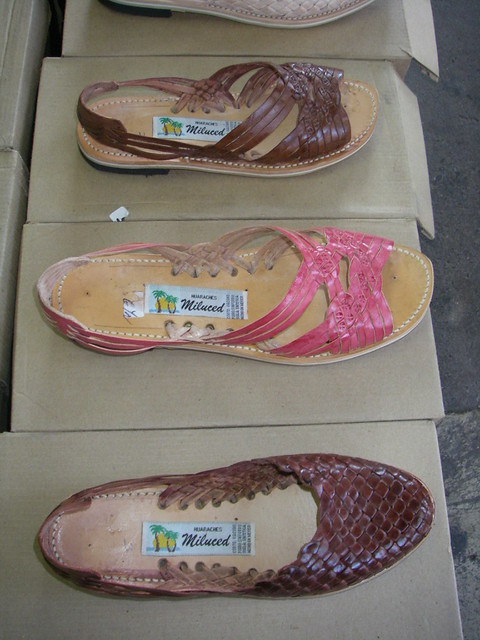
At the Mercado San Juan de Dios you can also see Huaracheros making Huaraches.
Since 1955 Senor Maximo Pellaio can usually found weaving in front of his Huarache stand.


I particularly liked his Huarache ‘Costeno’ also known as ‘Armadillo’.


Here was an old pair of ‘Pihuamo’, or ‘Tamazula’ Huaraches with a lot of character.

Senor Juan Saucedo is another distinguished Huarachero working in the Market. He has multiple University degrees and can be considered a philosopher as much as a Huarachero.

Senor Saucedo makes 268 Huarache designs, among the 40 or so styles in his shop this ‘Petatillo’ Huarache design which is quite hard to find in other parts of Mexico.


The Art of the Pihuamo Huarache
Posted: August 5, 2012 Filed under: Huarache Culture, Huarache Sandals, Huaraches Jalisco | Tags: メキシコのサンダル, ワラチ, चमड़े के सैंडल, बुना सैंडल, मेक्सिको सैंडल, हस्तनिर्मित सैंडल, Crafts, 编织凉鞋, Мексиканские сандалии, 革のサンダル, 멕시코 샌들, Gewebten Sandalen, Geweven Sandalen, Guadalajara, h, Handcrafted, Handgefertigte Sandalen, Handgjorda Sandaler, Handmade Sandals, Håndlagde Sandaler, Huarache, Huarache Sandals, Huaracheria, Huaraches, 짠 샌들, Lädersandaler, Ledersandalen, Meksikanske Sandaler, Mercado San Juan de Dios, Mexicaanse Sandalen, Mexican Crafts, Mexican Sandals, Mexico, Mexikanischen Sandalen, Mexikanska Sandaler, тканые сандалии, Sandales à la main, Sandales en Cuir, Sandales Mexicains, Sandales Tissées, Sandali fatti a mano, Sandali in Pelle, Sandali Intrecciati, Sandali Messicani, Sandalias de Cuero, Sandalias Guaraches, Sandalias Hechas a Mano, Sandalias Tejidas, Sandals, Skinn Sandaler, Traditional Footwear, Vävda Sandaler, Vevde Sandaler, Woven Footwear, Woven Sandals, 墨西哥凉鞋, 手工凉鞋, 手作りのサンダル, 不織布サンダル, المكسيكي الصنادل, المنسوجة الصنادل 1 CommentI was lucky to find these unfinished Huaraches from Huarachero Juan Saucedo at the Mercado Dan Juan de Dios in Guadalajara.
Working out of his Huaracheria in spaces 452-1048 since 1965, the protagonist of many Mexican press articles on the craft of Huaraches and with multiple academic degrees, Senor Saucedo is a remarkable Huaracehero.
Known as the ‘Tamazula’, or the ‘Pihuamo’ from the towns where they are traditionally made, I noticed this pair of Huaraches hanging at the back of his Huaracheria wall and realized how the artistic expression of the Huarache comes alive in it’s abstract form without sole.


Huaraches in Teocuitatlán de Corona
Posted: July 29, 2012 Filed under: Huarache Culture, Huarache Sandals, Huaraches Jalisco, Rare Huaraches | Tags: メキシコのサンダル, ワラチ, Crafts, Design, 革のサンダル, 멕시코 샌들, Footwear Design, Guadalajara, Handcrafted, Huarache, Huarache Sandals, Huaracheria, Huarachero, Huaraches, Mexican Crafts, Mexico, Sandals, Traditional Footwear, Woven Footwear, Woven Sandals, 手工凉鞋, 手作りのサンダル, 不織布サンダル 2 CommentsLike neighboring Amacueca and Concepción de Buenos Aires, Teocuitatlán de Corona is also well known for its Huarache traditions. Also a few hours south from Guadalajara, Teocuitatlán is a well preserved, small and quiet country town.

There are only 2 remaining Huaracheros in Teocuitatlán and one Huaracheria, this isn’t so bad if you consider that only one barber remains.
One Huarachero Sr. Manuel Vargas in la calle Morelos # 4, his ‘taller’ workshop just off the central plaza, opposite the church.


The Huarache style in Teocuitatlán de Corona is consistent with the Southern Jalisco natural leather and white ‘Oscaria’ blocking. The pair below also has a ‘Pico’ style sole shape as found in nearby Atoyac.


Cora Huaraches – Intensely Traditional
Posted: July 22, 2012 Filed under: Huarache Culture, Huarache Sandals | Tags: メキシコのサンダル, ワラチ, Crafts, 革のサンダル, 멕시코 샌들, Fashion, Footwear Design, Handcrafted, Huarache, Huarache Sandals, Huaraches, Mexican Crafts, Mexico, Old Photos, Sandals, Traditional Footwear, Woven Footwear, Woven Sandals, 手工凉鞋, 手作りのサンダル, 不織布サンダル Leave a commentI found this powerful photo in the 100 edition of Artes de Mexico. The edition titled ‘Los Otros Rostros’ is a tribute to Ruth Lechuga the great Anthropologist, preserver, promoter and sustainer of Mexican Folk Arts and Crafts.
This photo I found particularly striking (ignoring the text), because it puts Huaraches in yet another context. Not of fashion, not of poverty, not of craft, nor art, but one of intense tradition. Who said tradition is boring?

I was unable to find the photographer to credit for this photo, but will be glad to do so.
The Judea where this photos was taken is an Easter Ritual that merges Catholic and Indigenous themes.
Below is the link to a great photo essay of the Cora Judea celebration during ‘Semana Santa’ by Jan Sochor.
La Judea
Huaraches in Cuetzalan del Progreso
Posted: July 18, 2012 Filed under: Huarache Culture, Huarache Sandals | Tags: メキシコのサンダル, ワラチ, चमड़े के सैंडल, बुना सैंडल, मेक्सिको सैंडल, हस्तनिर्मित सैंडल, Barefoot Running, Crafts, 编织凉鞋, Мексиканские сандалии, 革のサンダル, 멕시코 샌들, Footwear Design, Gewebten Sandalen, Geweven Sandalen, Handcrafted, Handgefertigte Sandalen, Handgjorda Sandaler, Handmade Sandals, Håndlagde Sandaler, Huarache, Huarache Sandals, Huaracheria, Huaraches, 짠 샌들, Lädersandaler, Ledersandalen, Meksikanske Sandaler, Mexicaanse Sandalen, Mexican Crafts, Mexican Sandals, Mexico, Mexikanischen Sandalen, Mexikanska Sandaler, тканые сандалии, Pata de Gallo, Raramuri, Sandales à la main, Sandales en Cuir, Sandales Mexicains, Sandales Tissées, Sandali fatti a mano, Sandali in Pelle, Sandali Intrecciati, Sandali Messicani, Sandalias de Cuero, Sandalias Guaraches, Sandalias Hechas a Mano, Sandalias Tejidas, Sandals, Skinn Sandaler, Sustainable, Sustainable Footwear, Tarahumara, Traditional Footwear, Vävda Sandaler, Vevde Sandaler, Woven Footwear, Woven Sandals, 墨西哥凉鞋, 手工凉鞋, 手作りのサンダル, 不織布サンダル, المكسيكي الصنادل, المنسوجة الصنادل 2 CommentsCuetzalan del Progreso is a small market town tucked away in the northern mountains of Puebla.

The traditional footwear of this area is the ‘Pata de Gallo’ Huarache also known as the ‘Tres Piquetes’. As with many other indigenous Mexican traditions some local women still walk barefoot.


Similar to the ‘Pata de Gallo’ Huarache of the Raramuri/Tarahumara and the Huichol, the Huarache in Northern Puebla differs in that the leather strip is woven twice through the forefoot and usually requires no knot.

There is also another local ‘Pata de Gallo’ design variation and it includes a ‘Pechera’ flap over the arch and a ‘Rosadera’ strap on the heel.


When a Huarache sole wears down it is usual for a heel to be added.

You can get your ‘Pata de Gallo’ Huaraches made at 3 stands during the busy Sunday market and they cost about 80 Pesos per pair. The Huaraches all come with a thick vegetable tanned leather insole nailed over the the standard car tyre outsole.


There are also a few other varieties of Huaraches for sale in Cuetzalan that are also found in towns across the state of Puebla.


These ‘Tejido’ Huaraches caught my eye because the leather strip was not woven through the traditional ‘grapas’ (staples).


 Huarache Blog